Showing posts with label 2nd Doctor. Show all posts

Sunday, January 18, 2026

8-12. Second Chances.

CD cover for Second Chances.

2 episodes. Running Time: Approx. 68 minutes. Written by: John Dorney. Directed by: Lisa Bowerman. Produced by: David Richardson. Performed by: Wendy Padbury, Emily Pithon.


THE PLOT:

Zoe remains a prisoner of The Company, though her execution has been stayed after she provided some genuinely useful information. Her advocate, Jen, has brought in a specialist to try to recover more of her lost memories, and it's someone Zoe has met before. Under a different name, Kym (Emily Pithon) had attempted to trick Zoe into revealing the secret of the Achromatics. Her career was destroyed by Zoe's refusal, and she is deeply bitter.

With Kym's less-than-gentle prodding, Zoe is able to remember another incident. The TARDIS materialized on a space station, Artemis, where the Doctor, Zoe, and Jamie are mistaken for experts sent by The Company to advise on a situation. Their sister station, Apollo, broke up shortly after sending a coded message. Zoe sets to work decoding the message, only to discover a virus. By decoding it, Zoe has set it free to destroy Artemis!

In the present, Kym reveals that Earth has only just lost contact with space station Apollo. This means that there is still time for her and Zoe to travel to Artemis, to save the people on the station from a cold death in outer space. It's a chance for Zoe to correct her old mistake - and a chance for Kym to regain her lost position and set her own life back on track.


CHARACTERS:

The Doctor: There's an amusing moment in which he loses track of the TARDIS key because of how much junk he keeps in his pockets. When he finds it, he holds it up in triumph - only for his enthusiastic gesture to send the key flying through the air to land at the feet of the station security guards. When he briefly comes into contact with the older Zoe, whose face is hidden behind a mask, he seems to sense something, though there's no direct sign that he recognizes her.

Zoe: She is horrified when she realizes the nature of the virus, which is designed to modify itself to affect humans as well as code. Though there was nothing her younger self could have done differently, she still carries the guilt of the deaths that followed the virus's release, which makes Kym's offer to try to change the outcome irresistible. John Dorney's script makes the best use of Zoe's perfect memory that I've encountered in any story, with her total recall a key to the resolution - a particularly good thing in an arc whose released have been constantly punctuated by the older Zoe stating, "I remember everything."

Jamie: There's a nice in-joke, as Jamie complains about them landing in space stations when he'd really like them to materialize in a castle in Scotland, with the ensuing banter referencing the planned but unmade story, The Laird of McCrimmon. He also risks his life to rescue the younger Zoe, though this occurs offscreen as she's unconscious at the time.

Kym: The final story in this arc brings back the guest character from Echoes of Grey. There are even a few moments in which the narration switches from Zoe's recollections to Kym's, allowing quick glimpses into what motivates her and why she is so angry. She is impatient with Zoe, rushing her through key parts of the narrative, a clever justification for Dorney's script to create gaps that get filled when the Kym and the older Zoe arrive in person in Episode Two. Emily Pithon is given more emotional material here than in Echoes of Grey, and she rises to it with a strong performance.


THOUGHTS:

Second Chances is not only the final entry in the Zoe/memories arc; it was also the final release of the Companion Chronicles as a monthly range. It's an excellent curtain call for both, a cleverly plotted story that also delivers surprising emotional impact.

The first episode essentially presents an "average Troughton" episode, as Kym is able to make Zoe remember the adventure on the space station. This is an entertaining mini-adventure would make for an effective Short Trip in its own right, - but it's only at the end, when things go disastrously wrong, that it starts to seem like more than a just a standard Second Doctor adventure.

The second episode is where the story truly delivers, as we see the same events again from the viewpoint of the older Zoe. The story fills gaps that initially seemed to be throwaway jokes: Kym urging Zoe to skip past a capture/escape bit; Zoe being knocked unconscious. The flip side of the first episode's events reveals new information, and the overall context is changed and the stakes raised even further than they were already. A climax that seemed abrupt in the first episode becomes a genuinely exciting sequence, the change in perspective allowing for more development in Part Two.

The story does an excellent job of paying off the full arc. Previous stories have established The Company as ruthless and oppressive, more than enough reason to fear them obtaining this virus. This allows the older Zoe to finally do more than just remember - She acts, closing out the "frame" on a strong ending note.


OVERALL:

I thoroughly enjoyed Second Chances. It is easily the best of the Zoe/memories arc, satisfying both as a finale and as a solid tale in its own right. All told, this was probably as good an ending as could have been hoped for The Companion Chronicles as a monthly range.


Overall Rating: 10/10.

Set during: Season 6

Previous Story: The Uncertainty Principle

2nd Doctor Audio Review Index

2nd Doctor Television Review Index

Doctor Who: The Companion Chronicles Review Index

To receive new review updates, follow me:

On BlueSky:

On Threads:

Monday, April 15, 2013

7-8. House of Cards.


2 episodes. Approx. 57 minutes. Written by: Steve Lyons. Directed by: Lisa Bowerman. Produced by: David Richardson. Performed by: Anneke Wills, Frazer Hines.


THE PLOT

The Doctor decides it's time for a holiday, and so takes his companions to a casino in the distant future. Though Jamie and particularly Ben are thrilled at the chance to partake in some games, Polly does not like this place. She doesn't enjoy the gambling machines, she finds the sight of the transfixed gamblers downright disturbing... and that's even before she sets eyes on the snake-headed Sidewinder Syndicate, the gang that runs the casino's operations.

The Sidewinders work for a mysterious woman named Fortune, who has strict rules against time travelers. When the casino's alarms are tripped by a time travel device, Polly finds herself in the Sidewinder's sights - and escorted to Fortune's office. The woman is absolutely charming and utterly chilling as she gives Polly an ultimatum. It's a simple command: Push a button that will determine the winner of "The Game of Life."

It's no simple game, though. Two players sit in booths and, when the button is pressed, random chance will result in one being disintegrated. And much to Polly's horror, one of the players is Ben!


CHARACTERS

The Doctor:
 Though sidelined for most of the story, the Doctor registers strongly at the climax as he gambles with Fortune for the welfare of his companions... playing with a tattered Happy Families deck! Anneke Wills continues to do a fine job of suggesting Troughton's tone and vocal mannerisms and, even if she can't hope to replicate the eerily dead-on audio resurrection of Frazer Hines' readings, it's more than good enough to help the listener visualize the Second Doctor. It is a shame, though, that he's in so little of this one.

Polly: Polly is very much at the center of this story, and Steve Lyons shows the same facility with her character that marked his first Companion Chroncicle, Resistance. Polly is quick-thinking and courageous, but she is also easily surprised by the darker side of humanity. She is immediately repelled by the Sidewinder Syndicate, but it takes a few minutes for her to realize that the attractive and soft-spoken Fortune is actually much scarier than the snake creatures. She is too quick to trust Lucky Bill, which leaves her vulnerable to him when he acts out of desperation in Part Two.

Jamie: Frazer Hines is not doing double-duty this story, as he voices only Jamie and not the Doctor (or Ben). But he does get a substantial slice of the action, the script cutting away to his observations of a time traveling gambler in Part One and of havoc on the casino floor in Part Two. Hines and Wills, who were actually together in the recording booth for this story (earlier efforts had them record their parts separately), bounce well off each other, and it's actually a shame Jamie and Polly have only a couple of scenes together. 

Ben: Is largely sidelined, as usual. He isn't forgotten, however, as he falls under the influence of the gambling bug and manages to get himself into trouble in a way that spurs most of Polly's actions in Part Two. 


THOUGHTS

I had high expectations for House of Cards. It reteamed the same writer, performers, and companion line-up as the wonderful Selachian Gambit, and the science fiction casino setting seemed like a sure bet to produce another fun piece. I knew this was the reverse of that one - with Anneke Wills as the primary reader, and Frazer Hines the secondary one. Still, Wills is a fine reader, and the Companion Chronicle Resistance - also by Lyons - remains probably my favorite of Big Finish's Second Doctor stories, so it's not like this was a concern for me.

I will say that House of Cards is enjoyable. It moves along at a good pace, there are several fun scenes, and the movement back and forth from the main action with Polly to the side action involving Jamie keeps it alive. The Episode One cliffhanger is terrific, and the showdown between the Doctor and the story's villain is cleverly done.

But while it's an enjoyable story, I can't help but find it a disappointing one. Something is missing this time, and the magic that happened in The Selachian Gambit just doesn't happen in this story.

The companion line-up is definitely not as well utilized here as in the earlier story, with Ben and the Doctor sidelined for the bulk of the story. The caricatured Lucky Bill, complete with American western accent, is annoying in a bad way, and the potentially interesting Sidewinder Syndicate never develop beyond their initial beat as James Cagney-like gangster snakes.

I also think Lyons' attempt to use the time travel element by telling bits of the story out of sequence is a flourish that doesn't quite work. Some of it is clever, as we see scenes laying groundwork for something just shown. Other times, the cutting back and forth between action happening to Jamie and action that had happened to Polly simply becomes tiresome. There's a twist involving the identity of a woman in a china mask that is particularly oversold. By the third or fourth time Jamie obliquely referred to the woman as "my friend," I grew irritated enough to snap at the CD player that "I got it already, move along!"

Wills and Hines keep things afloat with their spirited reading, and Lyons is too good a writer not to make sure that the various events all patch together in a way that works. The way the second episode pays off the (very good) first episode cliffhanger in a way that fits but is completely unexpected is quite satisfying. Fortune, wonderfully voiced by Wills, is an effective villain, and her scenes opposite Polly in Part One and opposite the Doctor in Part Two are the best two scenes in the story. 

More of Fortune, particularly more of her opposite the Doctor, and less of Lucky Bill and the Sidewinders might have given this story the shot in the arm that it badly needs. As it stands, it's not at all bad. House of Cards is narratively solid and pleasant enough to listen to. But it never quite manages to connect the way the best stories do.

It's a perfectly okay story. It's just also a perfectly disposable one, and not one I expect to revisit.


Overall Rating: 6/10.

Previous Television Story: The Macra Terror
Next Television Story: The Faceless Ones


Search Amazon.com for Doctor Who

2nd Doctor Audio Review Index

2nd Doctor Television Review Index


Doctor Who: The Companion Chronicles Review Index

To receive new review updates, follow me:

On BlueSky:

On Threads:

Sunday, March 31, 2013

7-2. The Uncertainty Principle.

CD cover for The Uncertainty Principle.

2 episodes. Running Time: Approx. 64 minutes. Written by: Simon Guerrier. Directed by: Lisa Bowerman. Produced by: David Richardson. Performed by: Wendy Padbury, Charlie Hayes.


THE PLOT:

Zoe remains a prisoner of The Company, scheduled for execution after refusing to divulge details she observed when traveling with the Doctor. Her advocate, Jen (Charlie Hayes), tells her that her only hope of saving herself is to remember something of value - and time is running out.

With guidance from Jen, Zoe recalls a disruption forcing the TARDIS to materialize on Earth in the year 2022. She, the Doctor, and Jamie trace the disruption to a prototype Feynman machine. The computer isn't working - and the same failed experiment that grounded the TARDIS also resulted in the death of Meg, one of the researchers.

The time travelers pretend to be mourners at Meg's funeral in order to gather information, where Zoe befriends Archie, who was in love with the ill-fated scientist. Zoe finds herself drawn to the awkward young man, who accompanies them to Meg's lab. There, Zoe discovers the machine, which somehow is drawing creatures from another dimension - creatures made of electricity, whose merest touch results in instant death!


CHARACTERS:

The Doctor: Blends in at the funeral through the simple trick of listening to other people's stories about Meg and then parroting back some of her qualities. He survives his first encounter with the electricity creatures thanks to his rubber-soled shoes, though he is disconcerted that his hair has been left standing on end. The description of him trying to hand-comb it back into place is one that perfectly evokes Patrick Troughton's Doctor.

Zoe: She feels romantically drawn to Archie. He is far from her intellectual equal, but his social awkwardness leaves him not quite fitting in, something that she can relate to. In the present, she is still grappling with the gap in her mind. She's facing execution if she cannot give the Company what they want - but when she realizes exactly what their goal is, she contemplates that it might be better to just let herself die and take the information with her.

Jamie: He gets less to do than in the previous two Zoe Companion Chronicles, likely because some of his normal role ends up going to Archie. He gets one great scene, however. When Archie's mother is jeopardized by the creatures and her house is set on fire, Jamie doesn't hesitate to rush into the flames to save her. He protects her from the worst of the smoke inhalation, even though doing so puts him in the hospital.

Jen: There's an urgency to her attempts to get information from Zoe, and it gradually becomes clear that she has a strong personal stake in this. By the end, she realizes that Zoe would have helped her willingly... but after Zoe's previous unreliable narration, Jen simply did not see her as somebody she could trust.


THOUGHTS:

The Zoe/memories arc continues with its strongest release yet. It's as if writer Simon Guerrier specifically corrected for the weaknesses of the earlier entries. The main story is more interesting than that of Echoes of Grey, and its ending is more satisfying than that of The Memory Cheats.

The frame story has consistently been this arc's strongest feature, and it continues to build. Zoe's subterfuge when telling her previous story directly impacts how Jen approaches her this time. Because Zoe made herself seem unreliable, she is treated as such. The malice of The Company is also further developed, with stakes rising for both Jen and Zoe.

As was true of The Memory Cheats, Guerrier constructs his story around a central idea. This time, the theme is uncertainty. The story directly invokes the principle of Quantum Superposition, that something exists in multiple states until it is measured and fixed as one thing or another. This is reflected by Zoe herself, who lives with two sets of memories: one in which she traveled with the Doctor and one in which she stayed on The Wheel. It also relates to the creatures in her story, and eventually to the state of one of the supporting characters.

This is a good story, and I have only a couple of small nitpicks. There's a minor inconsistency that I was surprised slipped through: Zoe references Jamie throwing a glass of water at the creatures - something that was actually done by Archie, while Jamie was elsewhere. When the characters investigate Meg's lab, an echo effect is applied that's a touch overdone, which I found distracting.

These are minor issues, though, and they don't stop this from being a very good story.


Overall Rating: 8/10.

Set during: Season 6

Previous Story: The Memory Cheats
Next Story: Second Chances

2nd Doctor Audio Review Index

2nd Doctor Television Review Index


Doctor Who: The Companion Chronicles Review Index

To receive new review updates, follow me:

On BlueSky:

On Threads:

Wednesday, February 20, 2013

6-8. The Selachian Gambit.


2 episodes. Approx. 54 minutes. Written by: Steve Lyons. Directed by: Lisa Bowerman. Produced by: David Richardson. Performed by: Frazer Hines, Anneke Wills.


THE PLOT

The Doctor and his companions at a bank in the distant future for the most innocent of reasons.  It's just a simple misunderstanding involving a parking fine... Just enough cause for the Doctor to actually need a bit of money for once. But it's enough to place the Doctor, Jamie, Ben, and Polly in their usual position: The wrong place, at the wrong time. 

The Selachians are a race of aggressive, spacefaring sharks. Literal sharks, with fins and suits that preserve their acquatic environment as they move among the air-breathing plankton known as humanity. They are in the bank for the least innocent of reasons: To rob it. 

First they must breach the impregnable vault door, whose combination is changed multiple times daily. The vault is interdimensional, the combination setting the destination.  Enter the right combination and you can access the most valuable treasures of galactic civilization. Otherwise, even if you breach the door, all that you will find behind it is cold, empty space.

The Selachians are prepared to kill to get what they want, threatening to execute one hostage per minute. But the Doctor knows a thing or two about interdimensional locks, and he makes a deal with the aliens. If they agree to spare the hostages, he will use his considerable skills to break into the vault.

But there are secrets behind that door that even the Doctor isn't aware of - Secrets which make the lives of a mere twenty hostages insignificant in comparison!


CHARACTERS

The Doctor:
 One of the joys of Big Finish's Second Doctor stories has been Frazer Hines' Second Doctor. Hines is able to make himself truly sound like Patrick Troughton, to such a degree that more often than not you would swear Troughton was in the recording booth delivering his character's own lines. It was breathtaking even in Hines' earliest Big Finish stories, and his Troughton has gotten better and better as he's done more of them. 

This story is perfectly suited to the Second Doctor's persona. He is thrust into a situation in which he appears completely helpless. Then he uses his apparent weakness and his knowledge of interdimensional systems to barter with the Selachians. By Part Two, the bank heist is being run more by the Doctor than by the aliens, and listening as he defuses one potentially violent situation after another until the story's climax feels perfect for both character and era.

Jamie: Retains his tendency to sometimes act before he thinks, as when he makes an ill-advised (and poorly-aimed) attack on one of the Selachians early in the bank heist. His fierce loyalty to his friends is shown when, having made a clean escape for himself, he runs back into a building facing imminent destruction to save the Doctor and the other hostages. In an amusing nod to Big Finish's own continuity, Jamie and Ben consciously repeat a method of escaping their guards previously used in the Polly Companion Chronicle Resistance.

Ben: Frazer Hines' Ben voice is almost as good as his Second Doctor voice, allowing Ben to come to life in this story in a way that just wasn't true of the previous Companion Chronicles. As is usual, Ben is the least-used of the companions... but he still gets a decent slice of the action, working with Jamie to overcome Selachian guards near the end. Even his crawling through the bank's ductwork, which largely shunts him out of the way in Part One, pays off, with Ben making an important discovery.

Polly: When she hears the Doctor soothing Selachians and hostages alike by talking about a calming cup of tea, she knows what will come next. Sure enough, the next scene sees her sent to the kitchen to put the kettle on. As in The Moonbaseshe also actively looks around for things that might be used to turn the tables on the Selachians. With a helpful prod from Ben, she finds something. In Part Two, she is removed from the bank and mainly interacts with the police negotiating with the Selachians, which handily allows us to see both sides of the action. Anneke Wills continues to do a spirited job both in recreating her character and in narrating her portion of the story, and the switch back-and-forth between Hines' voice and hers helps to keep this serial alive and moving.


THOUGHTS

I've always enjoyed a good caper, which makes The Selachian Gambit a perfect fit for me. Writer Steve Lyons has concocted a textbook caper with the classic elements: A heist gone wrong, an impregnable security system, and a late-in-the-game twist that turns the story on its head. It's fast-paced and clever, making good use of its confined setting. 

The story also makes particularly good use of the regulars. The Season Four line-up of the Doctor, Jamie, Ben, and Polly can be daunting to cover in an audio story that runs less than 60 minutes. Resistance and The Forbidden Time both sidestepped the large line-up by separating the Doctor and Polly from the others for most of the action, effectively removing half the cast.

The Selachian Gambit properly uses all four regulars, and writer Steve Lyons manages to make this achievement look easy. One way in which this is done is by putting the companions into "teams" that are constantly switching. Polly and the Doctor are together initially, while Jamie and Ben observe some of the guest characters elsewhere in the bank. Then the Doctor and Jamie carry the main action for a while, while Polly and Ben interact elsewhere. Then Ben and Jamie are paired, while Polly interacts with the police outside the bank. It's a simple thing - but the shifting of the character pairs goes a long way toward keeping all the characters alive in the story throughout, while at the same time contributing to the fast pace.

The story benefits from Big Finish's usual polished production, but its success is brought home by Frazer Hines. His performance is nothing short of remarkable, as he enacts full scenes in which he voices every character. There's a tense scene in Part Two in which the Doctor, Jamie, the Selachians, Ben, and the bank manager all interact, discussing and threatening and arguing... and it was only after I had finished listening to the story that I reflected that this scene, and others like it, were created with a single actor. Between Hines' dead-on imitations of Patrick Troughton and Michael Craze, his ability to recreate his own 1960's performance, and his distinct voices for the guest characters, the story often feels less like an enhanced audio book than like a narrated full-cast play.

An outstanding central performance, bolstering an already well-constructed and clever story. It's often easiest to lavish praise on serious dramas than on lighter pieces like this one. But when a light story is pulled off as brilliantly as The Selachian Gambit is, then it deserves just as much praise. 

This is an excellent little story, one I will certainly revisit in the future. 


Overall Rating: 9/10.

Previous Television Story: The Macra Terror
Next Television Story: The Faceless Ones


2nd Doctor Audio Review Index

2nd Doctor Television Review Index


Doctor Who: The Companion Chronicles Review Index

To receive new review updates, follow me:

On BlueSky:

On Threads:

6-3. The Memory Cheats.

CD cover for The Memory Cheats.

2 episodes. Running Time: Approx. 65 minutes. Written by: Simon Guerrier. Directed by: Lisa Bowerman. Produced by: David Richardson. Performed by: Wendy Padbury, Charlie Hayes.


THE PLOT:

Zoe has been imprisoned and is facing execution in the wake of her refusal to share information with The Company.

She has one hope: Jen (Charlie Hayes), her defense attorney, dangles the prospect of leniency... but only if Zoe can remember her time with the Doctor. When Zoe insists again that she never actually traveled with him, Jen presents evidence: documents and photos that place her with the Doctor and Jamie in Uzbekistan, 1919.

This results in a breakthrough, with Zoe recalling that trip. She, the Doctor, and Jamie arrived in a village whose children were vanishing, one per night. Learning that the villagers are awaiting the arrival of Chebrakov, a Bolshevik official, the Doctor does what comes naturally: He impersonates the man in order to gain full access to investigate.

The children were taken from the poor and the privileged alike. At each house, the Doctor discovers a substance very like a spider's web. That night, the villagers remain awake and alert, and they are able to chase off what is either a badly deformed man or a creature. This leaves a trail for the time travelers to follow, to discover what became of the missing children.

Then the real Chebrakov arrives, and he has the expected reaction to the Doctor's impersonation: "I should have you all shot!"


CHARACTERS:

The Doctor: Impersonating a Bolshevik official grants him full access to investigate, and he swiftly notices the webs at the abduction sites. He's also able to connect the pieces of both the abduction and the still-recent war.

Zoe: She's the only person who isn't afraid of Chebrakov. She doesn't cow when he threatens to shoot her, instead calmly pointing out that it would be more to his advantage to use what they've already discovered to resolve the village's problem. She and Chebrakov genuinely like each other - which is not a point in her favor for Jen, who points out the types of deeds the Bolshevik would certainly have carried out to merit his position of power.

Jamie: He gains the trust of the village children by playing football with them. It's a bond that he solidifies when he stands up for a shy girl who doesn't want to talk to the Doctor, instead escorting the girl home so that they can talk to her mother. This is a terrific character scene that shows that while Jamie may not be as intellectually smart as the Doctor or Zoe, he is more emotionally intelligent than either of them.

Jen: Supposedly Zoe's defense attorney, Jen comes across more as an interrogator. She tells Zoe that she might gain clemency if she can provide The Company with information, and she guides her into first remembering, then telling the story. She is a mother herself, which makes her all the more invested in an incident involving kidnapped children.


THOUGHTS:

The Memory Cheats is a direct sequel to Echoes of Grey, with an older Zoe being prompted to remember details of her travels by people who want information from her. The frame creates tension, even more here than it did in the previous story, as Zoe is now in a much worse position than before.

Writer Simon Guerrier talks in the release's extras about the concept of investigating history. This is an area I've always found personally interesting. When you study past events, you're really having to interpret them using sources that are inherently biased: individual memories, often recounted decades after the events described; documents written by people serving their own agendas; and gaps that you have to attempt to fill through context. This is why, far from being static, history constantly changes: "accepted understanding" of the past shifts both with new discoveries and with changing standards.

The story plays with the idea of the unreliability of history. This is most apparent when Zoe challenges Jen, pointing out that from this point on, she could just make everything up and the other woman would never know it. The idea is also used when Jen prods Zoe's memory with records: the journal entries of a British doctor and his wife, or the likely (but unconfirmed) misdeeds of Chebrakov.

The first episode is by far the better of the two. There's just enough of the frame story to create tension, and writer Simon Guerrier does a splendid job of bringing the post-World War I setting to life. The village is still suffering from the ravages of war, and the citizens - rich and poor alike - are apprehensive of their new government. There are effective descriptions of how a poor family sleeps on the floor of their only room, with a contrast drawn between that family and another, more affluent one.

The second part takes the Doctor and his friends out of the village to find the children. It remains engaging. But for me, at least, once the characters leave the village, a lot of texture is lost.

The climax is my least favorite segment of the story. I like what it's trying to do, bringing the story to a close in a way that plays on the unreliability of Jen's sole source (Zoe). I also appreciate the way it draws parallels among the story Zoe relates, her life now, and Jen's own situation.

Unfortunately, I find the climax to be a bit of a jumble. Events are sketched rather than playing out, and critical moments seem brusehd over. This may serve the theme by stressing the unreliability of Zoe's account - but it comes at the expense of providing a satisfying conclusion, and I just don't find that to be a good tradeoff.


OVERALL:

A short epilogue between Zoe and Jen somewhat compensates, with each character challenging the other in a way that leaves the ongoing frame arc on a strong note. However, the resolution of the main plot remains disappointing to me.

The Memory Cheats is more ambitious than Echoes of Grey, with more intriguing ideas and a more detailed setting. But if pushed, I found Echoes more satisfying overall, simply because it felt more complete as a story.

I'd still rate it as a good release. But I was left feeling a little let down by the ending, which is enough to knock a point off my total score.


Overall Rating: 7/10.

Set during: Season 6

Previous Story: Echoes of Grey
Next Story: The Uncertainty Principle

2nd Doctor Audio Review Index

2nd Doctor Television Review Index


Doctor Who: The Companion Chronicles Review Index

To receive new review updates, follow me:

On BlueSky:

On Threads:

Tuesday, August 9, 2011

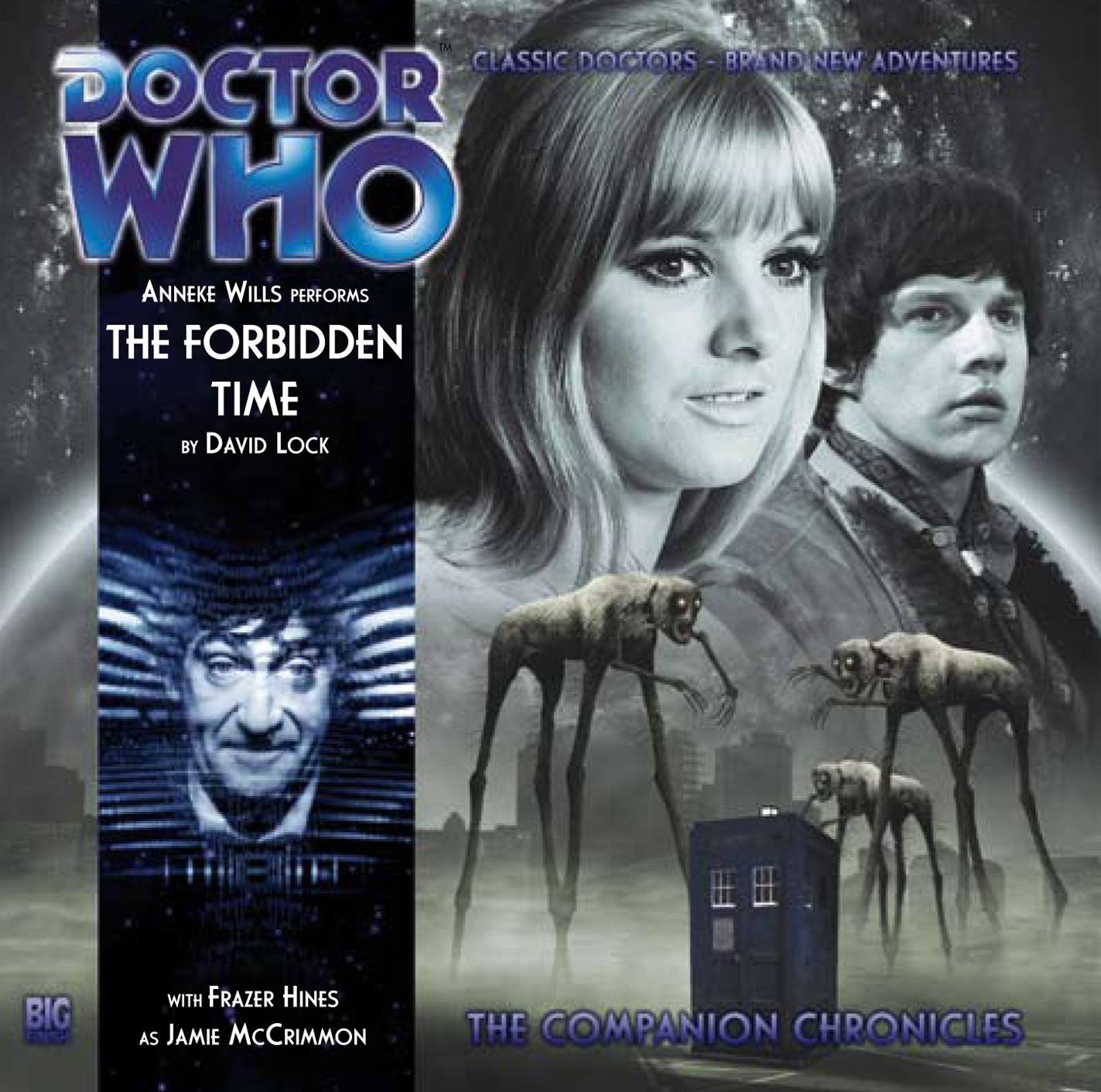
5-9. The Forbidden Time.


2 episodes. Approx. 62 minutes. Written by: "David Lock." Directed by: Lisa Bowerman. Produced by: David Richardson. Performed by: Anneke Wills, Frazer Hines.


THE PLOT

When the TARDIS encounters a barrier within the Time Vortex, the Doctor becomes determined to investigate. "People shouldn't build walls in the Time Vortex," he declares, while admitting that he hadn't previously thought it possible to do so. He, Ben, Polly, and Jamie step out of the TARDIS into 1970's London...

...And they find themselves in a shadow world. The physical landscape of London is intact, but it all has a sort of a gray, dead feeling. The Doctor announces that they have travelled sideways in time. The four head back to the TARDIS. But they are too late. The Vist - a species of alien Time Walkers - block their retreat. Separated from Jamie and Ben, the Doctor and Polly flee the Vist across this surreal, crumbling landscape!


CHARACTERS

The Doctor: The defining moment of the 2nd Doctor's run is almost certainly his declaration that evil does exist and must be fought. That said, there's an arresting visual moment at the end of this audio story, one that also sums him up well. He is facing the Vist, trying to summon up some fragments of authority. The monster laughs at the 2nd Doctor's disgust at its immorality, at his pretensions of authority. The Doctor talks at a rapid clip, and seems to talk himself into an even worse position than he was in already. Until we see that he has actually woven a web with his words, trapping the Vist by leading all of the aliens to do the one thing that can lead to their defeat. The small, foolish, disheveled little man, who is also the smartest and strongest presence in the room. If that's not the Troughton Doctor, what is?

Polly: Is clearly distraught when it appears Ben has been killed by the Vist, and she even refers to Ben as "my Ben" a few times during the story. With her highly empathic nature, it's not surprising that she's the first to notice the wrongness of this gray London, devoid of life. Despite this being a Companion Chronicle narrated by Polly, though, this story doesn't really do that much with her. She largely exists within the Doctor's shadow in this story, simply observing as he drives the action.

Jamie: Listening to this not long after watching/listening to several stories from Season Four, it is clear how much Frazer Hines' voice has changed in the intervening decades. That said, he has little difficulty in summoning up Jamie's basic character - no surprise, given how many times he's played the role for Big Finish over the past few years. Jamie is genuinely frightened of the Vist, but he still confides in a message to his friends that for all the dangers they've faced, he "wouldn't have missed (their adventures) for the world."

Ben: A secret car enthusiast. Ben confesses that every time the TARDIS has brought them back to London, in any time period, he checks out car magazines, and he can fairly accurately judge Earth time periods by this point by what cars are on the road (he and my father would certainly get on, though they'd probably drive any non-car enthusiast in earshot crazy). When the Vist block the TARDIS and move in on the Doctor and Polly, Ben doesn't hesitate to leap into the fray, putting himself at risk to distract the aliens' attention.


THOUGHTS

Written by the pseudonymous David Lock (identified by Wikipedia as Andy Lane), The Forbidden Time is a perfectly fine story. It's atmospheric, with Big Finish's sound designers doing their usual sterling job of creating an audioscape. It's highly visual, with the image of a parallel Earth, devoid of people and gray with decay, as its backdrop. It evokes the sense of the characters runnng through a Salvador Dali painting - with Dali even getting a namecheck by the script at one point!

For a story set during the black & white era of the television program, it's almost surprising how much use David Lock's script makes of color. The grayness of this world tips Polly off instantly that it's "wrong," and when the real world reasserts itself it's noted that the characters are moving "between black and white and color." The Vist's fortress is also detailed in a way that makes use of vivid colors. All of this brings the story to life. But while I normally visualize 1960's-set audios in black & white, this time the story was definitely in color.

This isn't the first Companion Chronicle to be read by two companions, but it may be the most ingenious use of the "second Companion." Jamie isn't simply a random second voice, dropped in whenever he has a line, nor is he an equal to Polly in telling the story. Instead, he is a supporting narrator, telling us Jamie's side of the story. This has the effect of letting us "cut away" from the Doctor and Polly to Jamie's scenes, in such a way that it doesn't compromise Polly as the principle narrator. It's clever.

Unfortunately, The Forbidden Time never quite gets beyond simply being clever. For the first episode, and the first bit of the second, I had hopes that this would be one of the range's most memorable outings. But once you get past the setting, the clever narrative devices, and the atmosphere, there just isn't much to the actual story. The Vist are a potentially strong adversary, and Anneke Wills does an effective job (with a boost from the sound designers) of making their voices genuinely eerie, if occasionally difficult to understand. But their agenda, when we discover it, is so... small, and frankly downright uninteresting. And the ending sees them far too easily defeated by the Doctor's fairly transparent ruse.

Ultimately, I enjoyed The Forbidden Time. The narrative devices are genuinely creative. The characters feel right. The production's general atmosphere and the typically strong reading by Anneke Wills make it an easy story to visualize. It just feels like this story should have been more than it is. I enjoyed the ride; I just wish I didn't feel vaguely dissatisfied at the end.


Rating: 5/10.

Previous Television Story: The Macra Terror
Next Television Story: The Faceless Ones

2nd Doctor Audio Review Index

2nd Doctor Television Review Index


Doctor Who: The Companion Chronicles Review Index

To receive new review updates, follow me:

On BlueSky:

On Threads:

Saturday, February 19, 2011

5-2. Echoes of Grey.

CD cover for Echoes of Grey.

2 episodes. Running Time: Approx. 77 minutes. Written by: John Dorney. Directed by: Lisa Bowerman. Produced by: David Richardson. Performed by: Wendy Padbury, Emily Pithon.


THE PLOT:

Decades after her time on the Wheel, Zoe Heriot is startled when she meets Ali (Emily Pithon), a young woman who remembers her from The Whitaker Institute, where she was among those saved by Zoe, Jamie, and the Doctor. This reinforces Zoe's own doubts about her memory. Ali suggests using a Delta Wave device to try to restore those lost memories, using her own recollections of the incident as a starting point.

This works, with Zoe soon recalling arriving in the TARDIS. Something is amiss. Hospital beds are identified with patient names, but there are no patients. The Doctor impersonates an official from the company backing the Institute, and the chief researcher, Dr. Cadden, grants them access - but carefully directed access, which leaves the Doctor fuming.

There's a lab that's kept off limits, supposedly due to contagion, and they hear whispers about "The Achromatics." A secret is being kept - and the consequences could be deadly!


CHARACTERS:

The Doctor: Impersonates a company official, freeing a captured Zoe and gaining access in a single move. After one person is killed, he tests Dr. Cadden by asking about the victim. When Cadden responds that he doesn't know where the man is, the Doctor knows that he's innocent; a guilty man would have had a story ready. Wendy Padbury does a much better job of capturing the Doctor here than in Fear of the Daleks, adopting a low, gravely tone that's a nice fit for the Second Doctor.

Zoe: She is mostly the standard Companion in the main story. She's in-character and active enough, but somewhat oddly for a Companion Chronicle, she doesn't particularly drive the plot. More interesting is the frame, which sees a middle-aged Zoe grappling with the hole in her memory. She tells Ali that she remembers wanting to travel with the Doctor, and then she simply... didn't. This mismatch makes her feel that she simultaneously remembers everything and nothing, and it leaves her primed to respond well to Ali's offer.

Jamie: Again oddly for a Zoe Companion Chronicle, Jamie has a stronger role in the main story than she does. He bickers with Zoe, who is irritated at him for a cut she sustained while trying to prepare haggis, grumbling that he can't help it if she can't follow basic cooking instructions. When he, the Doctor, and Zoe are threatened by the Achromatics, Jamie acts swiftly to throw the situation into chaos, allowing them to escape, and he pushes Zoe to climb to an at least temporary safety during the ensuing chase.

Ali: She bonds with Zoe over the difficulties of being a child prodigy. When she talks about being separated from her family and sent to work among adults who saw her as little more than a tool for calculations, Zoe admits that her story is almost identical. She pushes Zoe to remember, filling in the parts of the narrative that Zoe wasn't able to directly observe so that the story is complete.


THOUGHTS:

"I remember everything, and I remember nothing."
-Zoe Heriot grapples with lost memories.

There's a sharp divide in Echoes of Grey between the genuinely intriguing frame story and an entertaining but entirely standard main narrative.

The frame shows how the hole in her memory has affected Zoe's life and indicates that recovering her memories will make her feel whole again. It even folds in the bookends from Fear of the Daleks, with Zoe dreaming about traveling with the Doctor even though she knows she never did. It doesn't make Fear a better story, but it least it makes it less pointless. All of these scenes are quite good.

The story surrounded by that frame is a bit basic, a formulaic mystery/suspense story. There's nothing wrong with it. It moves along at a decent pace and everything is perfectly well-structured. The only problem is that it offers few surprises, with its major twist so clearly telegraphed early on that I doubt many listeners were at all surprised by it.

I still found it entertaining. John Dorney's script does a fine job of capturing the three regulars, and he's particularly good with the Jamie/Zoe dynamic. At one point, Jamie and Zoe hide in a closet to evade detection. Zoe shifts to peek through the gap in the door, digging into Jamie in a bit that would made for some amusing on-camera business; then the tone shifts toward horror as Zoe witnesses one of the Achromatics, leading to an effective cliffhanger.

Other than predictability, my main issue with this story is that Zoe doesn't actually do much. The frame presents an interesting dilemma, presenting an opportunity for her to recover her lost memories. But in the main plot, she gets the least to do of the three regulars. The Doctor puts the pieces together and resolves the incident; Jamie acts quickly to protect his friends; and Zoe... is there too. She's well-written and in-character. It just never feels like it's properly her story.


OVERALL:

If Echoes of Grey had been a television episode, its main plot would amount to midseason filler - but it would at least be pretty good midseason filler. It's far from indispensable, but it keeps me engaged throughout.

I wish I felt that the story was more centered around Zoe, rather than simply being a story that Zoe observes. Still, in the end I enjoyed Echoes of Grey, and I thought the frame was legitimately interesting. That's enough to boost my score by one point to...


Overall Rating: 7/10.

Set during: Season 6

Next Story: The Memory Cheats

2nd Doctor Audio Review Index

2nd Doctor Television Review Index


Doctor Who: The Companion Chronicles Review Index

To receive new review updates, follow me:

On BlueSky:

On Threads:

4-8. The Emperor of Eternity.


2 episodes. Running Time: Approx. 64 minutes. Written by: Nigel Robinson. Directed by: Lisa Bowerman. Produced by: David Richardson. Performed by: Deborah Watling, Frazer Hines.


THE PLOT:

The Doctor is quite pleased with himself when he manages to materialize on Earth immediately after the TARDIS is struck by a meteor. His smugness is short lived. While exploring their new surroundings, they find the dead of a massacred village. A traveler named Fen informs them that the townspeople were killed for believing that a recent meteor strike signaled the gods' displeasure with the emperor - the very meteor that the TARDIS deflected!

From Fen's statements, the Doctor realizes that he and his friends are in ancient China during the final part of the reign of Qin, the first emperor. Fen takes them to a nearby village for shelter. But it's not long before Imperial troops descend on the village, as well, taking the Doctor away to the Imperial palace. The emperor intends to force the time traveler to give him the secret of eternal life - leaving it up to Jamie and Victoria to rescue him!


CHARACTERS:

The Doctor: He recognizes that Fen is not who she says she is, but he plays along. He is appalled at the sight of the massacred villagers and, when the sadistic Lin threatens to do the same to the village where he's staying, he readily agrees to come with him. Since he knows that, according to history, the emperor will die soon, his plan is just to wait things out and let history take its course - at least, until Victoria reveals her suspicions that an assassin might be about to change history.

Victoria: This story emphasizes her compassion. She strongly believes that everyone is capable of redemption, as she tells Cho early in the story. When they traverse the corridor of molten silver, her background as a scientist's daughter serves her well - or maybe not so well, since she realizes what Jamie does not: That the liquid would be fatal if they fall in. Deborah Watling sometimes struggles when trying to recapture her young voice, but she does a good job of both reading and performing - and every so often, she manages to get a line just right, and the mental image of the young Victoria pops right into mind.

Jamie: Ever the protector, he tries to keep Victoria from seeing the corpses of the dead villagers. After seeing the field of bodies, he is wary of the strangers they meet to the point of hostility. He even voices the opinion that it would be all right if the emperor died. This is initially startling, but it does make sense - seeing those slaughtered villagers would almost certainly have brought back memories of his own clan. He also gets a couple moments to show that he is genuinely observant: He spots that Fen's horses are too regal for a peasant, and he demolishes Cho's pretense of being a monk with a series of observations that would have done Sherlock Holmes proud... though being Jamie, he immediately jumps to the wrong conclusions.

Fen: The young woman who takes the time travelers to the village, and later assists Victoria and Jamie in getting into the palace. The time travelers all spot that her story of being a peasant woman is clearly false. Her clothes, bearing, and even horses are far too aristocratic. Also, as Jamie notes, she is far too familiar with the secret way into the palace. The revelation of her true identity results in a memorable moment - though given the character's prominence in the story, it's disappointing that the revelation makes no real difference to the ending scenes.

Cho: The strange monk who appears in the village, only to immediately earn the suspicion of both Jamie and the villagers. He bonds with Victoria and seems genuinely moved by her statements about redemption and forgiveness - but when the Imperial soldiers ride into town, he hides himself immediately, only to take off toward the palace afterwards, which leaves the others convinced that he is an assassin.


THOUGHTS:

Emperor of Eternity has all the ingredients for a fine story. Writer Nigel Robinson describes the regulars' surroundings with a keen eye toward painting pictures in the listeners' minds. The setting, in ancient China, is inherently interesting. Lisa Bowerman directs with a steady hand, and the sound effects and music are carefully applied to make scenes that little bit more vivid.

It also ends up being a tale of two halves. The first episode is very good, with several memorable moments: the discovery of the dead villagers, Jamie's verbal sparring with Cho, the violent arrival of the Imperial guards, and the cliffhanger (and pickup in Episode Two) with Victoria finding an army of clay soldiers. All of this contributes to the atmosphere and helps raise tension while establishing the stakes.

Even in the first episode, however, most listeners will spot some of the tropes the story invokes. One narrative turn is so obvious that I called it by the thirty-minute mark. Still, as long as the story remained good, I could forgive such contrivances. It's not like televised Doctor Who in any era has gone out of its way to avoid such things.

Unfortunately, the second episode is much weaker. Not initially - the first ten minutes or so of Part Two remain strong, even if one obstacle in the characters' path feels a little too much like something out of a video game. But the momentum stalls once Victoria and Jamie reunite with the Doctor, and the story gets progressively worse from that point on - right up to an ending that's both limp and trite.

This was Deborah Watling's second, and last, Companion Chronicle. As was true of The Great Space Elevator, she struggles audibly to recapture her 1960s performance for Victoria's actual dialogue. She also has difficulty in differentiating the voices of the characters, which occasionally makes it hard to tell which person is speaking.

Still, Watling does just fine when directly reading. She brings the descriptions and action to life with suitable emotion and energy, and there was no point in which I had trouble picturing where the characters were and what their situation was. It's a perfectly fine audiobook performance - It just feels a bit more like a reading and less like a performance than the work of certain other narrators.


OVERALL:

For the first 40 minutes, I'd have labeled The Emperor of Eternity a good story, even a very good one. Then it starts to deteriorate, sliding into an ending that just doesn't work for me at all. There is still much to enjoy here - but the final Act leaves a poor last impression.


Overall Rating: 5/10.

Previous Television Story: The Web of Fear
Next Television Story: Fury from the Deep

2nd Doctor Audio Review Index

2nd Doctor Television Review Index


Doctor Who: The Companion Chronicles Review Index

To receive new review updates, follow me:

On BlueSky:

On Threads:

4-2. The Glorious Revolution.

CD cover for The Glorious Revolution.

2 episodes. Running Time: Approx. 58 minutes. Written by: Jonathan Morris. Directed by: Nigel Fairs. Produced by: David Richardson. Performed by: Frazer Hines, Andrew Fettes.


THE PLOT:

It's been roughly forty years since James Robert McCrimmon had his memories wiped by the Time Lords before being returned to his own time. He's settled down and has enjoyed a long and happy life. Then a Time Lord agent (Andrew Fettes) arrives to question him about a divergence in history. The agent restores his memory, then probes Jamie about the time he, the Doctor, and Zoe visited the year 1688.

Jamie recounts how they materialized just in time to save a young woman from a mob. She turned out to be the wife of King James II (also Fettes), fleeing with her infant son in the final days of her husband's reign. When Jamie realizes that they've landed on the eve of "The Glorious Revolution," in which King James was overthrown by William III, he decides to change history.

He meets King James and urges him not to flee, which became the pretext for William to depose him. He makes a persuasive case, even presenting a plan for the beleaugured king to get the population to side with him, if only to be on the winning side. But as the change takes hold, Jamie begins to experience strange lapses - and in his present, even as he shares his story with the Time Lord agent, his memories begin to change to reflect the new reality that he created!


CHARACTERS:

The Doctor: He's horrified by Jamie's actions and is determined to make sure history follows its proper course. An amusing moment has him thinking quickly when they're discovered by a boatman, assuming an authoritative posture and ordering the man to search all boats - even as he and Jamie continue with their escape in their own vessel. Hines's Troughton impression, which was already good in Helicon Prime, is terrific here. Unlike in the earlier audio, there aren't any deliveries in which he doesn't adopt the "Troughton voice," and it can be easy to forget that the same actor is voicing both roles.

Jamie: As good as Frazer Hines's Troughton is, his best acting comes when Jamie angrily talks about how the transfer of power was only peaceful in England: "No one died - in England! A peaceful exchange of power - in England! ...The Glorious Revolution was only glorious for the English. For the rest of us, in Scotland and Ireland, it was the beginning of a civil war!" The refrain of "in England" grows steadily more ferocious as the speech goes on, and the bitterness with which Jamie spits those two words are all the more effective for the contrast with his usual laid-back demeanor.

Zoe: Given that Zoe is usually more knowledgeable than Jamie, this particular setting allows a reversal. For Jamie, this is history that is barely out of living memory that has continued to impact his present, so he's extremely familiar with it. For Zoe, the entire "Glorious Revolution" is ancient history, leaving her needing the Doctor and Jamie to explain it to her. Hines does a decent job of differentiating her lines from the male characters, giving her a softer tone. 


THOUGHTS:

Big Finish's second Jamie Companion Chronicle is far better than Helicon Prime. Frazer Hines again gives a good reading, creating different voices not only for the three regulars, but also for multiple guest characters. The result feels only a step removed from being a full cast story, which helps to lend immediacy to events.

I usually prefer the Companion Chronicles that don't bother with framing devices, as most of the time those frames end up feeling labored and/or tacked on. Writer Jonathan Morris makes good use of the frame, though, weaving what initially seems to be just a bookend into the story in what I think is the range's cleverest way since Frostfire. Jamie's past actions change reality for the older Jamie even as he tells his story, and the interactions of Jamie and the Time Lord agent end up having an impact on the story being told.

The frame is also used for a strong character moment. Once his memories are restored, Jamie complains about his memory being wiped. The agent justifies it by pointing to the good life he's led, a life he might not have enjoyed had he known what was taken from him. Jamie angrily rebuts that he was given no choice - an anger not dissimilar to what he feels within the main story, in both cases reacting to decisions imposed by those who considered themselves above mere peasants.

Save for the time paradox issue (which not enough is made of), this is mostly a pure historical. Morris's script takes care to give us enough context to understand what is happening in the tale without smothering the story in details. The script maintains an energetic pace, moving quickly from one plot point to the next. There's also a rather nice action set piece with Jamie staging an exciting (if unlikely) rescue to save the Doctor and Zoe from a hangman's noose.

While it's a good story, I don't think it quite manages to be a great one. King James's characterization is inconsistent, with him veering from defeated to despotic within a single scene, only to become entirely passive again thereafter. I also think that more might have been done with the effects of Jamie's change to history. I think the story suffers slightly from being restricted to a single disc. At two episodes, it's sprightly, clever, and enjoyable - but the ideas and concepts here would have been more fully explored had this been about twice as long.


OVERALL:

The Glorious Revolution has the humor you'd expect of a story set in Season Six, but it also shifts seamlessly to some strong emotional moments. Jamie's eruption at the Doctor over the "peaceful" revolution is a highlight, an excellent character scene that also serves as a reminder that historical events can look a lot different depending on where one is standing.

Frazer Hines's performance is excellent. His Second Doctor is so good that I sometimes forgot it wasn't Patrick Troughton performing, and his acting as Jamie ranks among his best in the franchise.

Certain aspects feel underdeveloped, I suspect because of the short running time, and that costs the story a point. But this is an all-around good title, one that's well worth a listen.


Overall Rating: 8/10.

Set During: Season Six

2nd Doctor Audio Review Index

2nd Doctor Television Review Index


Doctor Who: The Companion Chronicles Review Index

To receive new review updates, follow me:

On BlueSky:

On Threads: